What is a Nation?

In his influential 1882 essay “What Is a Nation?” French philosopher Ernest Renan wrote about the bonds that hold nations together. He explained, “A heroic past, great men, glory [are the links between people] upon which one bases a national idea. . . . A nation is . . . a large-scale solidarity, constituted by the feeling of sacrifices that one has made in the past and of those that one is prepared to make in the future.” Others have stressed language, ethnicity, or even pseudo- scientific ideas about “race.” The migration of people between one nation and another is challenging long-held assumptions about who belongs.
https://www.facinghistory.org/civic-dilemmas/what-nation

China’s ‘purification’ of classrooms: A new law erases history, silences teachers and rewrites books

With China’s tightening control over Hong Kong, including passage of a new national security law, the territory’s pro-democracy activists, politicians, journalists and others are facing a Communist Party determined to crush dissent. Perhaps the greatest threat from this new purge — one that will affect generations to come — is the increasing pressure on schools and teachers over what to put in the minds of students. Both activists and bureaucrats know that a nation’s soul is distilled in the classroom; history can be erased with the silencing of teachers and rewriting of textbooks.

https://www.latimes.com/world-nation/story/2020-09-11/hong-kong-teacher-purge

‘Kill All You See’: In a First, Myanmar Soldiers Tell of Rohingya Slaughter

Video testimony from two soldiers supports widespread accusations that Myanmar’s military tried to eradicate the ethnic minority in a genocidal campaign.

On Monday, the two men, who fled Myanmar last month, were transported to The Hague, where the International Criminal Court has opened a case examining whether Tatmadaw leaders committed large-scale crimes against the Rohingya.

The atrocities described by the two men echo evidence of serious human rights abuses gathered from among the more than one million Rohingya refugees now sheltering in neighboring Bangladesh. What distinguishes their testimony is that it comes from perpetrators, not victims.

Emigration Rises Along with Economic Development. Aid Agencies Should Face This, but Not Fear It

Within low-income countries, richer people are more likely to emigrate. And as low-income countries economically grow, people are more likely to emigrate.

But we shouldn’t use a fear of migration as a reason to keep poor countries poor. That would ignore the inherent value of poverty reduction, as well as harm donor countries’ own interests in a prosperous, healthy, and stable world. Rather, these facts matter because development policy that is not based on facts never works. Development assistance should engage with human mobility—not to deter it, but to shape it for mutual benefit.

https://www.cgdev.org/blog/emigration-rises-along-economic-development-aid-agencies-should-face-not-fear-it

The world’s money transfer system is China’s Achilles heel in its sanctions battle against the US

But China is actually far more vulnerable to US sanctions than it will let on, even if the sanctions are aimed at individuals and not banks. That’s because the primary system powering the world’s cross-border financial transactions between banks, Swift, is dominated by the US dollar.

https://qz.com/1893235/swift-transfer-system-leaves-china-vulnerable-to-us-sanctions/

Official economic forecasts for poor countries are too rosy

Over-optimism at the IMF and the World Bank can have serious consequences

Predicting growth, and especially downturns, is fiendishly hard. Getting it right is not helped by forecasters having little incentive to spot clouds on the horizon. Analysts fear that gloom could become self-fulfilling. Standing out from the crowd and wrongly calling a recession damages a forecaster’s reputation more than failing to predict one along with everyone else. Then there is “pushback from governments”, says Maurice Obstfeld, who was the fund’s chief economist in 2015-18.

https://www.economist.com/finance-and-economics/2020/08/04/official-economic-forecasts-for-poor-countries-are-too-rosy?fbclid=IwAR15q_kYPy97nRti1ZrYAjVm07vLb_wwqjE9cAVJZ-9aKCsewOHCoxUoKa4

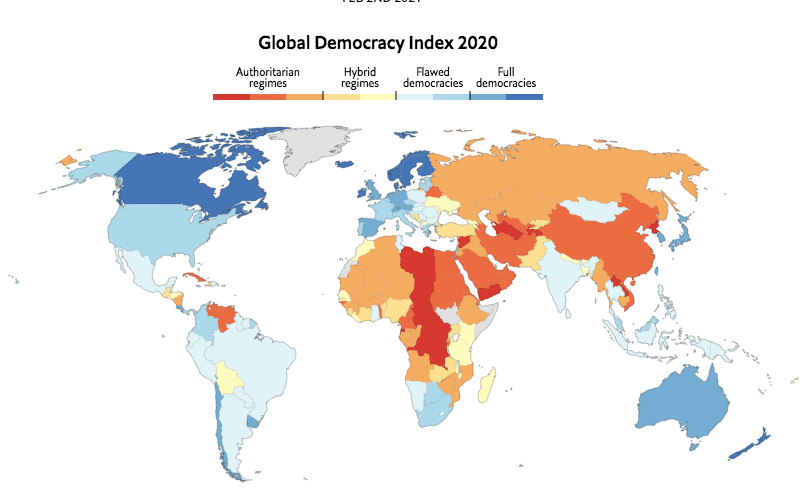
Global democracy has a very bad year

The pandemic caused an unprecedented rollback of democratic freedoms in 2020

Government-imposed lockdowns and other pandemic-control measures led to a huge rollback of civil liberties in 2020, causing downgrades across the majority of countries. Confronted by a new, deadly disease to which humans had no natural immunity, most people concluded that preventing a catastrophic loss of life justified some temporary loss of freedom. The ranking penalised countries that withdrew civil liberties, failed to allow proper scrutiny of emergency powers or denied freedom of expression—regardless of whether there was public support for government measures. In France for example, severe lockdowns and national curfews led to a small but significant decrease in its overall score and the country dropped into the “flawed democracy” category.

https://www.economist.com/graphic-detail/2021/02/02/global-democracy-has-a-very-bad-year

Top international court rejects Uighur calls to investigate China for alleged genocide

The office of prosecutor Fatou Bensouda said the ICC couldn’t act because China is not a signatory to the court.

The Uighurs had argued that even though the alleged deportations did not happen on Chinese soil, the ICC could act because they happened on Tajik and Cambodian territory, and both of them are ICC members.

https://www.sbs.com.au/news/top-international-court-rejects-uighur-calls-to-investigate-china-for-alleged-genocide/e20763c3-33be-48fc-8941-1a07945b5a96

Trump’s deal on Morocco’s Western Sahara annexation risks more global conflict

Last week, President Trump formally recognized Morocco’s annexation of Western Sahara as part of a deal to get Morocco to normalize relations with Israel. But Morocco’s claim on Western Sahara is rejected by the United Nations, the World Court, the African Union and a broad consensus of international legal scholars that consider the region a non-self-governing territory that must be allowed an act of self-determination. This is why no country had formally recognized Morocco’s takeover — until now.

https://www.washingtonpost.com/opinions/2020/12/15/trump-morocco-israel-western-sahara-annexation/

Under a Divisive Peace, Wartime Rifts Hobble Hope in Bosnia

The Dayton Accords, which ended fighting in the country 25 years ago, created a dysfunctional system that put power in the hands of politicians stoking ethnic division.

His refusal to put identity politics at the center of his business, however, has put him sharply at odds with a system created by the 1995 peace settlement that revolves around ethnicity and loyalty to one ethnonationalist authority or another. It has also crippled one of the few success stories in a country blighted by what reports to the United Nations Security Council in April and May described as “chronic dysfunctionality” and “the pandemic called corruption.”