Donald Trump’s sanctions in the Middle East have had little effect ($)

Four years of economic warfare against Iran and its allies have barely changed their behaviour.

“Maximum pressure”, as Mr Trump calls it, has been a tactical success. In April Iran’s oil exports dipped as low as 70,000 barrels per day, compared with 2.5m two years before. (Exact numbers are elusive because much of Iran’s oil trade is now done in secret.) The rial, Iran’s currency, has lost 85% of its value. Yet economic pain has not brought political change. Sanctions have not compelled Iran to halt its support for militias nor convinced Bashar al-Assad, the Syrian dictator, to stop bombing his people. Sanctions may be an alluring tool for presidents. They are inexpensive, bloodless and largely up to executive discretion. But they often do not work.

Sanctions can be effective when they have broad international support, achievable demands and are targeted at firms and people that need to trade and travel. A multilateral embargo on Iran led to the deal in 2015 that restricted its nuclear programme. Sanctions on Rusal, a Russian aluminium giant, forced a Kremlin-backed oligarch to surrender control of the firm.

Mr Trump’s maximum-pressure campaign, however, fulfils none of these criteria. For a start, many of his sanctions are unilateral, and some have begun to fray. Iran’s oil exports have climbed from their nadir in April, perhaps to as high as 1m barrels a day this autumn, as some countries (particularly China) have defied American threats and snapped up discounted crude.
https://www.economist.com/middle-east-and-africa/2020/11/26/donald-trumps-sanctions-in-the-middle-east-have-had-little-effect

Throughline Podcast: The Sunni-Shia Divide

The Sunni-Shia divide is a conflict that most people have heard about – two sects with Sunni Islam being in the majority and Shia Islam the minority. Exactly how did this conflict originate and when? We go through 1400 years of history to find the moment this divide first turned deadly and how it has evolved since.

https://www.npr.org/2020/12/07/943938323/outside-in-war-of-the-worlds


Colombia’s Angela Merkel moment

Colombian President Iván Duque earlier this week announced that as many as 1.7 million Venezuelan migrants currently in Colombia will now be authorized to live and work legally in the country for ten years.

As humanitarian gestures by world leaders go, it’s hard to find something on this scale in recent history.

German Chancellor Angela Merkel’s fateful “Wir schaffen das” (We can do this) decision in 2015 allowed up to one million refugees to apply for asylum. Duque’s move, by contrast, welcomes nearly twice that number of people to stay for at least a decade.

https://www.gzeromedia.com/colombias-angela-merkel-moment


Is This the End of Neoliberal Globalization? ($)

The ideology underpinning neoliberal globalization demands that all markets and exchanges, large and small, global and local, be optimized for profit. This has been the mantra of corporate executives and elites for the past four decades. Empty hospital beds cost money. Local production is too expensive. Stockpiles of surgical masks and ventilators are a waste of money. Community hospitals in poor and rural counties won’t turn a profit, so they must be closed.

https://jacobinmag.com/2020/05/is-this-the-end-of-neoliberal-globalization


https://drive.google.com/file/d/1u15wh_L6g3Re5nBgzwZohhhPNhdwZ42H/view?usp=sharing

The Attack Of The Civilization-State


As a civilization-state, China is organized around culture rather than politics. Linked to a civilization, the state has the paramount task of protecting a specific cultural tradition. Its reach encompasses all the regions where that culture is dominant.

The importance of this concept became more obvious to me in India during a conversation with Ram Madhav, the general secretary of the ruling Bharatiya Janata Party. After a conference in Delhi, he explained: “From now on, Asia will rule the world, and that changes everything because in Asia, we have civilizations rather than nations.”

The Attack Of The Civilization-State

How Brexit happened ($)

Britain went from enthusiastic commitment to the EU to an acrimonious departure on unfavourable terms

Britain’s history meant it was always ambivalent towards the European “project”. For most continental countries, building European unity was a reaction to the horrors of the second world war and its aftermath. The Germans were escaping Nazism, the French defeat and collaboration, the Italians dictatorship, the eastern Europeans, when they eventually joined, Soviet domination. Britain was the only member that felt no need to escape from its past—indeed, in many ways, it preferred wallowing in the past to confronting the future. For Britain, unlike the rest of Europe, the nation state is something to be celebrated rather than transcended.

https://www.economist.com/britain/2021/01/02/how-brexit-happened

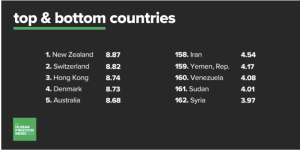
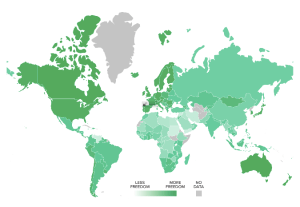
Personal Freedom on the Decline Worldwide: New Human Freedom Index

Overall freedom has also declined, though to a lesser degree, over the same time period. Of the 12 major categories that we measure in the report, all but five have seen some deterioration, with freedom of religion, identity and relationship freedoms, and the rule of law seeing the largest decreases.

https://www.cato.org/blog/personal-freedom-decline-worldwide-new-human-freedom-index


How Space Became the Next ‘Great Power’ Contest Between the U.S. and China

The Biden administration faces not only waves of Chinese antisatellite weapons but a history of jumbled responses to the intensifying threat.

“There’s been a dawning realization that our space systems are quite vulnerable,” said Greg Grant, a Pentagon official in the Obama administration who helped devise its response to China. “The Biden administration will see more funding — not less — going into space defense and dealing with these threats.”

The protective goal is to create an American presence in orbit so resilient that, no matter how deadly the attacks, it will function well enough for the military to project power halfway around the globe in terrestrial reprisals and counterattacks. That could deter Beijing’s strikes in the first place. The hard question is how to achieve that kind of strong deterrence.

How the Arab spring engulfed the Middle East – and changed the world

An era of uprisings, nascent democracy and civil war in the Arab world started with protests in a small Tunisian city. The unrest grew to engulf the Middle East, shake authoritarian governments and unleash consequences that still shape the world a decade later

Our interactive timeline captures the way the Arab spring emerged and then spread with remarkable speed and force across the Middle East. The information has been compiled by the Guardian based on news coverage and reports from human rights organisations, and is therefore not an exhaustive record. It is a visual retelling of key protests, moments of regime change and outbreaks of civil war that transformed the Middle East and wider world.

https://www.theguardian.com/world/ng-interactive/2021/jan/25/how-the-arab-spring-unfolded-a-visualisation

Colombia’s peace tribunal issues a crushing judgment against the FARC ($)

A system established to achieve “transitional justice” proves its mettle

The jep’s revelations show that Colombia’s unique “transitional-justice” system can succeed. Most such tribunals have been established by international bodies, such as the un. The jep is the first such body for prosecuting war crimes and crimes against humanity to have been created by the warring parties through a peace accord. It adjudicates such crimes through “restorative”, rather than retributive, justice. This seeks to reconcile victims with offenders, mostly by uncovering the truth. The tribunal talked to more than 2,500 kidnapping victims. Colombia’s ordinary justice system had not done that when it tried some farc members in absentia during the war. The jep took testimony from the hostage-takers, who under the peace agreement are obliged to confess. Some spoke for 16 hours.

https://www.economist.com/the-americas/2021/02/02/colombias-peace-tribunal-issues-a-crushing-judgment-against-the-farc