Where Will Everyone Go?

ProPublica and The New York Times Magazine, with support from the Pulitzer Center, have for the first time modeled how climate refugees might move across international borders. This is what we found.
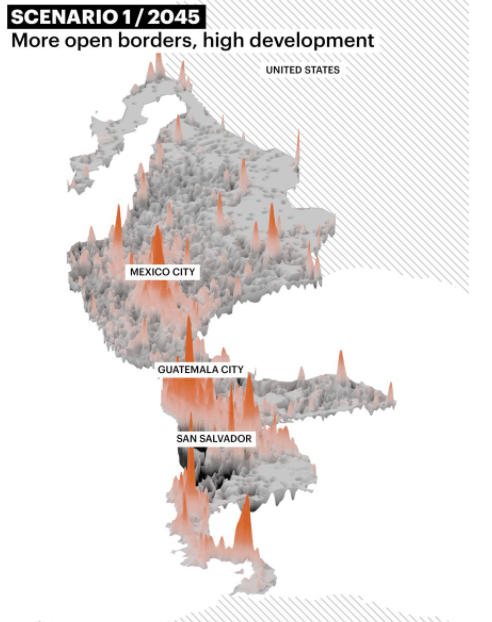
Scientists have learned to project such changes around the world with surprising precision, but — until recently — little has been known about the human consequences of those changes. As their land fails them, hundreds of millions of people from Central America to Sudan to the Mekong Delta will be forced to choose between flight or death. The result will almost certainly be the greatest wave of global migration the world has seen.

https://features.propublica.org/climate-migration/model-how-climate-refugees-move-across-continents/

Emigration Rises Along with Economic Development. Aid Agencies Should Face This, but Not Fear It

Within low-income countries, richer people are more likely to emigrate. And as low-income countries economically grow, people are more likely to emigrate.

But we shouldn’t use a fear of migration as a reason to keep poor countries poor. That would ignore the inherent value of poverty reduction, as well as harm donor countries’ own interests in a prosperous, healthy, and stable world. Rather, these facts matter because development policy that is not based on facts never works. Development assistance should engage with human mobility—not to deter it, but to shape it for mutual benefit.

https://www.cgdev.org/blog/emigration-rises-along-economic-development-aid-agencies-should-face-not-fear-it

Official economic forecasts for poor countries are too rosy

Over-optimism at the IMF and the World Bank can have serious consequences

Predicting growth, and especially downturns, is fiendishly hard. Getting it right is not helped by forecasters having little incentive to spot clouds on the horizon. Analysts fear that gloom could become self-fulfilling. Standing out from the crowd and wrongly calling a recession damages a forecaster’s reputation more than failing to predict one along with everyone else. Then there is “pushback from governments”, says Maurice Obstfeld, who was the fund’s chief economist in 2015-18.

https://www.economist.com/finance-and-economics/2020/08/04/official-economic-forecasts-for-poor-countries-are-too-rosy?fbclid=IwAR15q_kYPy97nRti1ZrYAjVm07vLb_wwqjE9cAVJZ-9aKCsewOHCoxUoKa4

‘It’s cultural genocide’: inside the fight to stop a pipeline on tribal lands

The Line 3 route traverses land that Native American pipeline opponents say is protected by US treaties with Ojibwe nations

There are numerous sites in Minnesota, along the new Line 3 route, where water protectors have set up camp. Much of the route goes through tribal lands, as well as Minnesota’s iron range and areas popular for recreation, including hunting, fishing and people enjoying the outdoors.

It is a lush, wooded part of the state, thick with birch and pine trees, pristine lakes, rolling creeks and lakes filled with wild rice, an agricultural product that is historically significant to the Ojibwe.

https://www.theguardian.com/us-news/2021/feb/19/line-3-pipeline-ojibwe-tribal-lands

There’s a Global Plan to Conserve Nature. Indigenous People Could Lead the Way.

Dozens of countries are backing an effort that would protect 30 percent of Earth’s land and water. Native people, often among the most effective stewards of nature, have been disregarded, or worse, in the past.

Nature is healthier on the more than quarter of the world’s lands that Indigenous people manage or own, according to several scientific studies. Indigenous-managed lands in Brazil, Canada and Australia have as much or more biodiversity than lands set aside for conservation by federal and other governments, researchers have found.

China’s Belt and Road: Implications for the United States

The Belt and Road Initiative (BRI), Chinese President Xi Jinping’s signature foreign policy undertaking and the world’s largest infrastructure program, poses a significant challenge to U.S. economic, political, climate change, security, and global health interests. Since BRI’s launch in 2013, Chinese banks and companies have financed and built everything from power plants, railways, highways, and ports to telecommunications infrastructure, fiber-optic cables, and smart cities around the world. If implemented sustainably and responsibly, BRI has the potential to meet long-standing developing country needs and spur global economic growth. To date, however, the risks for both the United States and recipient countries raised by BRI’s implementation considerably outweigh its benefits.

What 100 contracts reveal about China’s development lending ($)

Loans are not obviously predatory; secrecy is sometimes a condition

China insists it is helping poor countries follow in its own debt-financed footsteps, offering the kind of patient capital other lenders are now too wary to provide. China’s critics instead accuse it of drenching countries in red ink, then grabbing strategic assets, such as ports or mines, as collateral when a country defaults.

https://www.economist.com/finance-and-economics/2021/03/31/what-100-contracts-reveal-about-chinas-development-lending

Planet Money Podcast Episode 755: The Phone At The End Of The World

Tierra del Fuego is home to penguins, grey skies and brutal winds. It’s the last stop for ships before making the final leg to Antarctica.

Today on the show, how a town at the ends of the earth wound up making Blackberry phones, and what happened to when a charismatic president launched a big plan to create jobs and boost manufacturing.

https://www.npr.org/sections/money/2017/02/17/515850029/episode-755-the-phone-at-the-end-of-the-world

🎧 When Foreign Aid Fails

Foreign aid is meant to alleviate suffering and help poor countries develop. But according to William Easterly, a professor of Economics at NYU, it often does the opposite. Instead of helping countries develop, it wastes resources or makes it harder for them to make economic progress. And far from advancing democracy and human rights, it often helps autocrats to stay in power.

In this week’s episode of The Good Fight podcast, Yascha Mounk and William Easterly discuss how political considerations misdirect foreign aid, whether the “development industrial complex” ignores the human rights of the poor, and why foreign aid so often gives a lifeline to authoritarian leaders around the globe. 

https://www.persuasion.community/p/-when-foreign-aid-fails-democracy

Foreign Affairs Backstory on Trade and Worker Protections

It has become an axiom in American politics that workers have suffered at the hands of globalization. As economic integration connected the world, opportunities dried up at home. “A responsible policy would capture the gains of free trade but make up for domestic losses,” Gordon Hanson writes. “In recent years, the United States has done neither.”

https://link.foreignaffairs.com/view/59a88934b84a99d70c8b567ee2lrr.nkg/b9bbd09d