American power ($)

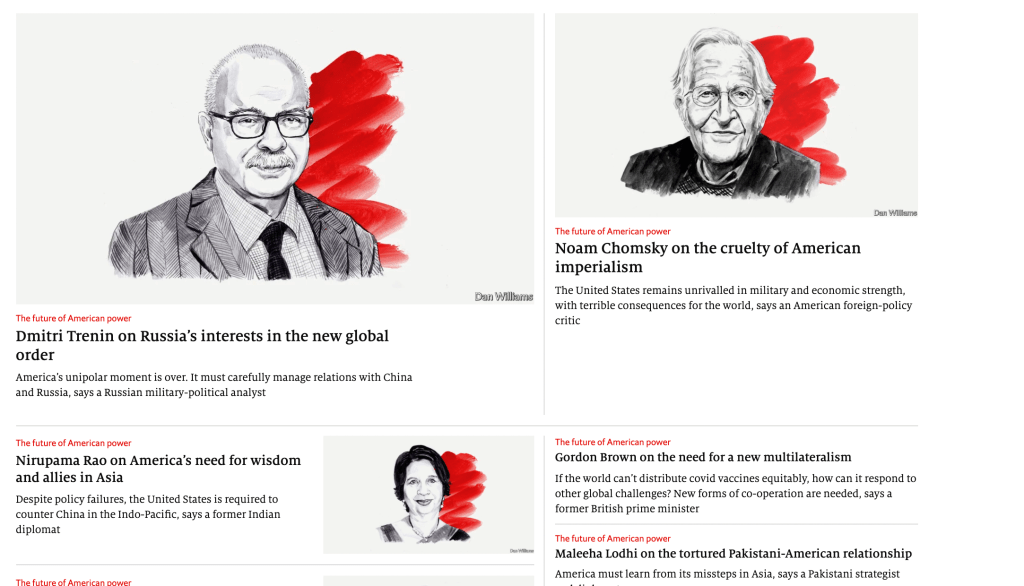
The global order that America helped to establish in the second half of the 20th century is changing fast. In this collection of commentaries, global thinkers examine the sources of America’s power and the forces changing it. They offer predictions and prescriptions for the future. The series looks broadly at America’s power, from its chaotic abandonment of Afghanistan to the rise of China. It also considers the internal forces at work in the United States.

https://www.economist.com/future-of-american-power

When Does Activism Become Powerful?

My colleagues and I studied places in the United States where people’s activism actually had an impact — places where leaders built a constituency and turned the actions of that constituency into countervailing power. We interviewed experts all over the country to identify these outliers, then selected six of them for deep investigation. The six represented different issues, different places and different constituencies. We asked, what do they have in common?

The Small-State Survival Guide to Foreign Policy Success

Small states are more likely to be perceived as neutral, trustworthy and compliant value-creators in negotiations.

Small states are certainly disadvantaged in the international system. Having a small population inherently inhibits the aggregate structural power of that state, as well as creating hurdles that need to be compensated for and unique needs that have to be fulfilled. Small states are geographically and economically diverse, and thus face different challenges in terms of security and welfare. Nonetheless, they all have to compensate for size-related problems and meet needs that are inherent to their smallness.

https://nationalinterest.org/feature/the-small-state-survival-guide-foreign-policy-success-22526

Azerbaijan’s drones owned the battlefield in Nagorno-Karabakh — and showed future of warfare

Drone strikes — targeting Armenian and Nagorno-Karabakh soldiers and destroying tanks, artillery and air defense systems — provided a huge advantage for Azerbaijan in the 44-day war and offered the clearest evidence yet of how battlefields are being transformed by unmanned attack drones rolling off assembly lines around the world.

https://www.washingtonpost.com/world/europe/nagorno-karabkah-drones-azerbaijan-aremenia/2020/11/11/441bcbd2-193d-11eb-8bda-814ca56e138b_story.html

Bretton Woods Revisited

Good history of the US Dollar system and its implications

The way the modern system works is that money has network effects, and the US is a large economy with an extraordinarily well-developed financial sector, so any asset is priced in dollars by default. Bilateral trade between non-dollar, non-Euro countries countries is usually done in dollars, so a 1% increase in the value of the dollar leads to a 0.6-0.8% change in trade between all other countries.

https://diff.substack.com/p/bretton-woods-revisited

Private Israeli spyware used to hack cellphones of journalists, activists worldwide

Military-grade spyware licensed by an Israeli firm to governments for tracking terrorists and criminals was used in attempted and successful hacks of 37 smartphones belonging to journalists, human rights activists, business executives and two women close to murdered Saudi journalist Jamal Khashoggi, according to an investigation by The Washington Post and 16 media partners.

https://www.washingtonpost.com/investigations/interactive/2021/nso-spyware-pegasus-cellphones/

Donald Trump’s sanctions in the Middle East have had little effect ($)

Four years of economic warfare against Iran and its allies have barely changed their behaviour.

“Maximum pressure”, as Mr Trump calls it, has been a tactical success. In April Iran’s oil exports dipped as low as 70,000 barrels per day, compared with 2.5m two years before. (Exact numbers are elusive because much of Iran’s oil trade is now done in secret.) The rial, Iran’s currency, has lost 85% of its value. Yet economic pain has not brought political change. Sanctions have not compelled Iran to halt its support for militias nor convinced Bashar al-Assad, the Syrian dictator, to stop bombing his people. Sanctions may be an alluring tool for presidents. They are inexpensive, bloodless and largely up to executive discretion. But they often do not work.

Sanctions can be effective when they have broad international support, achievable demands and are targeted at firms and people that need to trade and travel. A multilateral embargo on Iran led to the deal in 2015 that restricted its nuclear programme. Sanctions on Rusal, a Russian aluminium giant, forced a Kremlin-backed oligarch to surrender control of the firm.

Mr Trump’s maximum-pressure campaign, however, fulfils none of these criteria. For a start, many of his sanctions are unilateral, and some have begun to fray. Iran’s oil exports have climbed from their nadir in April, perhaps to as high as 1m barrels a day this autumn, as some countries (particularly China) have defied American threats and snapped up discounted crude.

https://www.economist.com/middle-east-and-africa/2020/11/26/donald-trumps-sanctions-in-the-middle-east-have-had-little-effect
The Attack Of The Civilization-State


As a civilization-state, China is organized around culture rather than politics. Linked to a civilization, the state has the paramount task of protecting a specific cultural tradition. Its reach encompasses all the regions where that culture is dominant.

The importance of this concept became more obvious to me in India during a conversation with Ram Madhav, the general secretary of the ruling Bharatiya Janata Party. After a conference in Delhi, he explained: “From now on, Asia will rule the world, and that changes everything because in Asia, we have civilizations rather than nations.”

The Attack Of The Civilization-State

How Brexit happened ($)

Britain went from enthusiastic commitment to the EU to an acrimonious departure on unfavourable terms

Britain’s history meant it was always ambivalent towards the European “project”. For most continental countries, building European unity was a reaction to the horrors of the second world war and its aftermath. The Germans were escaping Nazism, the French defeat and collaboration, the Italians dictatorship, the eastern Europeans, when they eventually joined, Soviet domination. Britain was the only member that felt no need to escape from its past—indeed, in many ways, it preferred wallowing in the past to confronting the future. For Britain, unlike the rest of Europe, the nation state is something to be celebrated rather than transcended.

https://www.economist.com/britain/2021/01/02/how-brexit-happened

How Space Became the Next ‘Great Power’ Contest Between the U.S. and China

The Biden administration faces not only waves of Chinese antisatellite weapons but a history of jumbled responses to the intensifying threat.

“There’s been a dawning realization that our space systems are quite vulnerable,” said Greg Grant, a Pentagon official in the Obama administration who helped devise its response to China. “The Biden administration will see more funding — not less — going into space defense and dealing with these threats.”

The protective goal is to create an American presence in orbit so resilient that, no matter how deadly the attacks, it will function well enough for the military to project power halfway around the globe in terrestrial reprisals and counterattacks. That could deter Beijing’s strikes in the first place. The hard question is how to achieve that kind of strong deterrence.