American power ($)

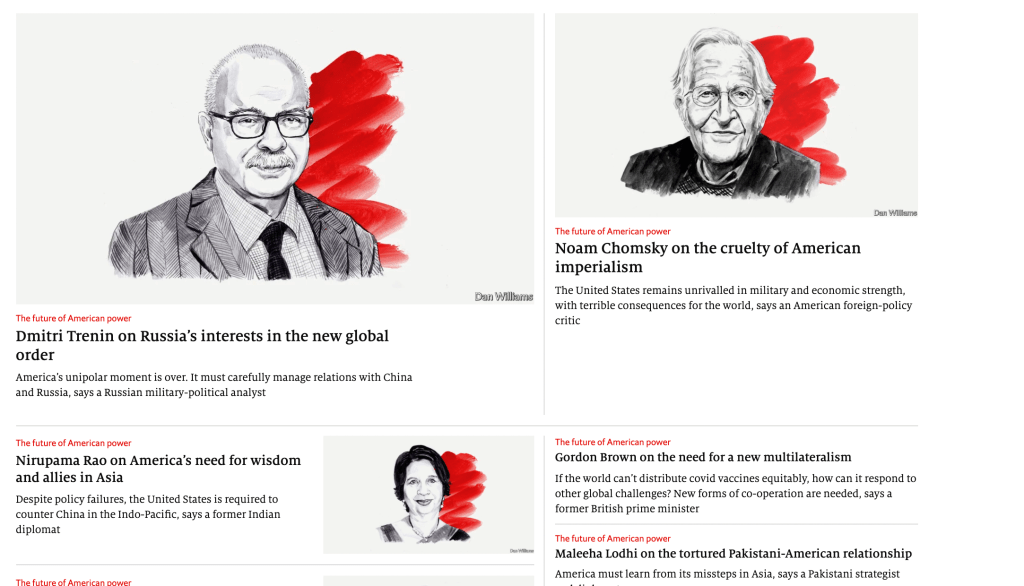
The global order that America helped to establish in the second half of the 20th century is changing fast. In this collection of commentaries, global thinkers examine the sources of America’s power and the forces changing it. They offer predictions and prescriptions for the future. The series looks broadly at America’s power, from its chaotic abandonment of Afghanistan to the rise of China. It also considers the internal forces at work in the United States.
https://www.economist.com/future-of-american-power

HOW THE U.S. DERAILED AN EFFORT TO PROSECUTE ITS CRIMES IN AFGHANISTAN

“This just proves one more time to Afghans that international mechanisms do not value their life when foreigners are involved and international forces are involved,” Shaharzad Akbar, who chaired Afghanistan’s Independent Human Rights Commission until the Taliban took control of the country in August, told The Intercept. “This decision reinforces the perception that these institutions set up in the West and by the West are just instruments for the West’s political agenda.”

https://theintercept.com/2021/10/05/afghanistan-icc-war-crimes/

The Afghanistan occupation and the Japan occupation

We learned the wrong lessons from our post-WW2 success

To many Americans, wrapped up in their insular worldview, the answer is simple: U.S. occupation transformed the country into what it is today. Take a fascist dictatorship, add some U.S. soldiers, and shazam, rich liberal democracy! So of course the fact that we can no longer seem to pull off this sort of trick means that we’re a fallen, diminished empire and blah blah. 

https://noahpinion.substack.com/p/the-afghanistan-occupation-and-the?

We All Lost Afghanistan: Two Decades of Mistakes, Misjudgments, and Collective Failure ($)

The broader questions about why Afghanistan finds itself at this juncture undermine attempts to justify the “war on terror” as it was waged in the country over two decades. During my more than three years in Kabul, between 2013 and 2016 (including as U.S. ambassador from 2014 to 2016), it became evident to me just how steep the challenges to U.S. strategy were. Although we were largely successful in eliminating al Qaeda in the country and reducing the threat of terrorist attacks in the United States, we failed in our approach to counterinsurgency, to Afghan politics, and to “nation building.” We underestimated the resiliency of the Taliban. And we misread the geopolitical realities of the region.

What does a Taliban takeover of Afghanistan actually mean?

It happened faster than most people expected, but the US-backed Afghan government has now fallen. The Taliban have taken over the capital, Kabul, and installed themselves in the presidential palace. Thousands of Afghans are scrambling to leave amid uncertainty of what comes next for the war-torn country. Chaos reigns.

https://www.gzeromedia.com/what-does-a-taliban-takeover-of-afghanistan-actually-mean

Wisdom of Crowds Podcast: Who Wrecked Afghanistan?

How did it all go wrong? Jennifer Brick Murtazashvili, a leading scholar of Afghanistan, joins Damir and Shadi to dissect the Taliban’s victory and discuss what it tells us about the failures of America’s nation-building effort. Why did the Afghan government collapse so quickly? Have the technocrats and NGOs in the democracy promotion industry been completely discredited? And for the sake of the Afghan people, should we now help the Taliban succeed in governing the country? Things get heated.

https://wisdomofcrowds.live/who-wrecked-afghanistan/

The Violent Logic of Humanitarianism

The U.S. occupation of Afghanistan sacrificed politics—the only viable route to peace—for massive corruption and violence, all committed in the name of humanitarian compassion.

“The idea that we’re able to deal with the rights of women around the world by military force is not rational.” This single sentence from President Biden’s ABC interview with George Stephanopoulos on August 18 exposed the paradox of humanitarian intervention. It acknowledged that trying to address violence with violence only serves to perpetuate it. 

https://bostonreview.net/war-security/faisal-devji-violent-logic-humanitarianism