How Chinese Financing is Fueling Megaprojects Around the World
August 15, 2021
This report, based on interviews with over 60 people over two years, shows how officials within the Cambodian government, and CHNG and its subsidiaries, did not adequately consult with impacted communities and affected families before or during the construction of the Lower Sesan 2 dam. It documents how officials ignored communities’ concerns and objections, dismissed calls for discussion of alternative project designs, provided wholly inadequate compensation to impacted communities, and failed to set up an effective grievance mechanism to address disputes. Government and company officials made no attempt to obtain the “free, prior, and informed consent” of affected Indigenous peoples, as specified under the United Nations Declaration on the Rights of Indigenous Peoples.
(Above is the full report, below is a shorter news story about the report)
Almost a third of the alleged abuses recorded from 2013 to 2020 have taken place in Southeast Asia, including Myanmar, Laos, Cambodia and Indonesia.
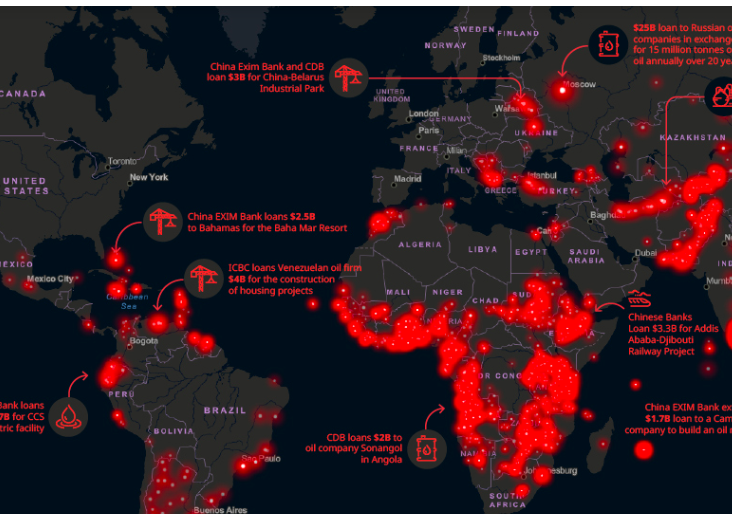
China is undertaking massive infrastructure projects across the world and loaning billions of dollars to developing nations. On paper, the objective is to build a vast trade network, but is China also exporting authoritarianism?
The Belt and Road Initiative (BRI), Chinese President Xi Jinping’s signature foreign policy undertaking and the world’s largest infrastructure program, poses a significant challenge to U.S. economic, political, climate change, security, and global health interests. Since BRI’s launch in 2013, Chinese banks and companies have financed and built everything from power plants, railways, highways, and ports to telecommunications infrastructure, fiber-optic cables, and smart cities around the world. If implemented sustainably and responsibly, BRI has the potential to meet long-standing developing country needs and spur global economic growth. To date, however, the risks for both the United States and recipient countries raised by BRI’s implementation considerably outweigh its benefits.
Loans are not obviously predatory; secrecy is sometimes a condition
China insists it is helping poor countries follow in its own debt-financed footsteps, offering the kind of patient capital other lenders are now too wary to provide. China’s critics instead accuse it of drenching countries in red ink, then grabbing strategic assets, such as ports or mines, as collateral when a country defaults.
Yet this raises questions whether Duisburg – dubbed by local media as “Germany’s Chinese city” – is opening itself up to ethical compromises or reputational risk by so openly welcoming Chinese investment. The pressure Beijing exerts on foreign entities is increasing, at a time surveys show the German public is increasingly negative on Chinese investment. What price is paid to engage with China?
Great summary of a specific place affected by new infrastructure, the hopes and realities.
Locals are making money from tourism and are buying more yaks, Abbas says. This year, he began with 500 and sold all but 32. “People like it because they don’t eat anything other than grass,” he says, sounding more like a hipster butcher than a grime-streaked 23-year-old shepherd. Before the road was fixed, he was selling barely 15 a year, and was surviving on chai and bread.
The bustle is apparent in the nearby border town of Sost, where cargo trucks come from across Pakistan to collect Chinese imports processed at the local dry port. Dozens of men sit outside, waiting for dollar-a-day jobs unloading boxes. Mohammad Iqbal, a 29-year-old customs official, says that when he was growing up, “there was only one shop, only one hotel.”
It is not just American businesses that are figuring out how to balance the ethical demands of their domestic public with those coming out of an increasingly influential China.
 An IB Global Politics Site