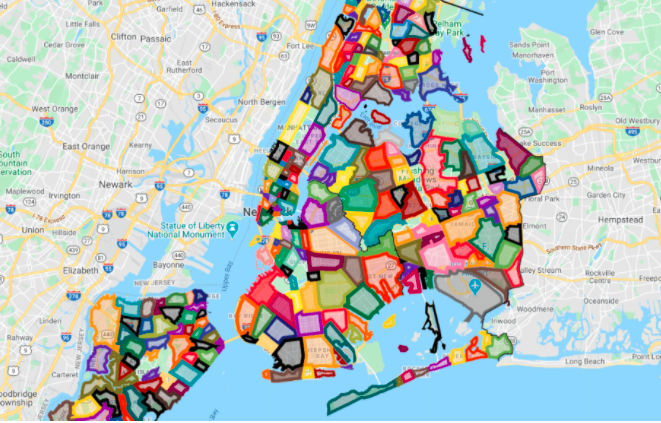
This Map Shows Where All NYC Neighborhood Borders Are Once & For All
August 11, 2021
The Norwegian territory of Svalbard has been open to citizens of the world since 1920. But don’t call it a utopia.
What I discovered was a historical accident, rooted in environmental determinism and shaped by economics, that is being irreversibly upended. There’s a dismal symmetry at play: As climate change renders the rest of the planet as hostile to human life as the far north, we too must make the choice between throwing up walls and letting them down. Svalbard’s geopolitics provide an imperfect but alternative vision of how places can be governed, whom they can accommodate, and how communities can form.
https://www.thenation.com/article/archive/svalbard-arctic-open-borders/
ProPublica and The New York Times Magazine, with support from the Pulitzer Center, have for the first time modeled how climate refugees might move across international borders. This is what we found.
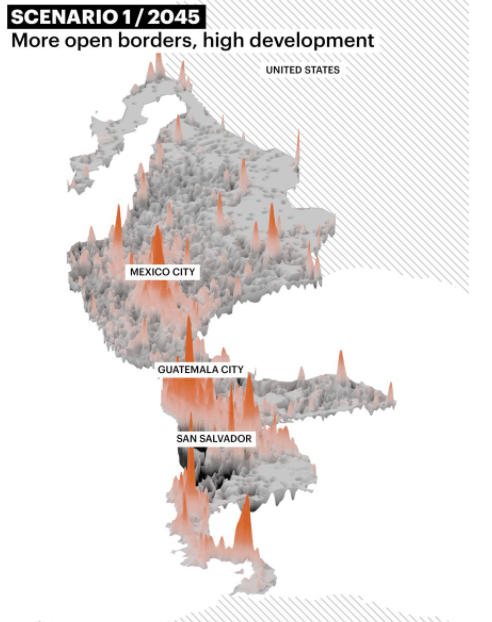
Scientists have learned to project such changes around the world with surprising precision, but — until recently — little has been known about the human consequences of those changes. As their land fails them, hundreds of millions of people from Central America to Sudan to the Mekong Delta will be forced to choose between flight or death. The result will almost certainly be the greatest wave of global migration the world has seen.
https://features.propublica.org/climate-migration/model-how-climate-refugees-move-across-continents/
Armenians and Azerbaijanis coexisted in Soviet days. But conflict over the disputed territory exploded in the late 1980s, leaving festering wounds that have erupted anew.
Armenians and Azerbaijanis lived side by side in the Soviet days, until conflict over the disputed mountain territory called Nagorno-Karabakh exploded in the late 1980s into riots, expulsions and a yearslong war. The violence left personal wounds festering for decades, as stubborn as the tan and gray stone ruins of Azerbaijani villages still scattered in the Armenian countryside.
Armenians and Azerbaijanis lived side by side when both countries were part of the Soviet Union, but century-old ethnic enmity reignited when communism collapsed. Nagorno-Karabakh, mainly ethnic Armenian, ended up as part of Azerbaijan. Armenia won a war over the territory in the early 1990s that killed some 20,000 people and displaced a million, mostly Azerbaijanis.
Azerbaijanis were expelled not only from Nagorno-Karabakh itself but also from seven surrounding districts, including Kelbajar, that had been mostly inhabited by Azerbaijanis. The entire region became the internationally unrecognized, ethnic Armenian Nagorno-Karabakh Republic. Azerbaijan’s desire to return its citizens who had been displaced from their homes became a driving force in its politics.
At dozens of internal checkpoints across the country, Border Patrol agents stop and question passing motorists on their citizenship. Elsewhere, officers engage in roving traffic stops aimed at interdicting illegal immigration inside the United States. Agents at checkpoints require neither a warrant nor individualized suspicion to stop passing motorists and inquire about the occupants’ citizenship, or to inspect private lands within twenty-five miles of the border. Taken together, these “defense in depth” measures amount to an extraordinarily expansive law enforcement effort carried deep into the U.S. interior.
The Norwegian territory of Svalbard has been open to citizens of the world since 1920. But don’t call it a utopia.
When you land in Longyearbyen, the largest settlement in the Norwegian archipelago of Svalbard, you can step off the plane and just walk away. There’s no passport control, no armed guard retracing your steps, no biometric machine scanning your fingers. Svalbard is as close as you can get to a place with open borders: As long as you can support yourself, you can live there visa-free.
That doesn’t make Svalbard an egalitarian place—far from it.
https://www.thenation.com/article/svalbard-arctic-open-borders/
President Recep Tayyip Erdogan’s war is an ethnonationalist attack on Kurds and their aspirations.
Mr. Erdogan’s war is an ethnonationalist attack on Kurdish people and their aspirations, and an attempt at using Turkish military might to engineer demographic changes on land that belongs to more than one nation.


 An IB Global Politics Site