The Battle Line for Western Values Runs Through Poland

The European Union is the West’s last line of defense. The United States has historically been the world’s anchor of republican ideals, but President Trump has abandoned the role, openly admiring strongmen like Vladimir Putin of Russia. As the temptations of nationalist populism spread, Europe has responsibility for holding down the Western fort. The primary battle right now is over Poland, which is deepening its descent into illiberalism. The European Union needs to take a firm stand in defense of Western values.

‘Against supranationalism: in defence of national sovereignty (and Brexit)’

The repercussions of the post-national ideology that (re-)emerged in the 1980s, and then became all-pervasive in the 1990s and 2000s, are still being felt today. Conventional wisdom holds that that globalisation and the internationalisation of finance has ended the era of nation-states and their capacity to pursue policies that are not in accord with the diktats of global capital. But does the evidence support the assertion that national sovereignty, which so often throughout the twentieth century has been wrongly proclaimed dead, has truly reached the end of its days?

https://plutopress.wordpress.com/2017/09/22/against-supranationalism-in-defence-of-national-sovereignty-and-brexit-by-bill-mitchell-and-thomas-fazi/?fbclid=IwAR0AF6flPugXpm35RrT1CQOaN8zKwINDBhOlr48MRvGhb3ZGIGu9OnbetXY

After the Liberal International Order

If Joe Biden defeats Donald Trump in November, the question he will face is not whether to restore the liberal international order. It is whether the US can work with an inner core of allies to promote democracy and human rights while cooperating with a broader set of states to manage the rules-based international institutions needed to face transnational threats.

https://www.project-syndicate.org/commentary/biden-must-replace-liberal-international-order-by-joseph-s-nye-2020-07

Bound to Fail: The Rise and Fall of the Liberal International Order

I offer three main sets of arguments. First, because states in the modern world are deeply interconnected in a variety of ways, orders are essential for facilitating efficient and timely interactions. There are different kinds of international orders, and which type emerges depends primarily on the global distribution of power. But when the system is unipolar, the political ideology of the sole pole also matters. Liberal international orders can arise only in unipolar systems where the leading state is a liberal democracy.

https://direct.mit.edu/isec/article/43/4/7/12221/Bound-to-Fail-The-Rise-and-Fall-of-the-Liberal#.Xt2mKjLdbEM.twitter

Personal Freedom on the Decline Worldwide: New Human Freedom Index

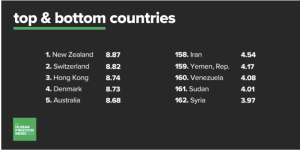
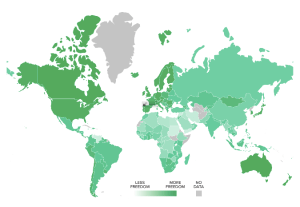
Overall freedom has also declined, though to a lesser degree, over the same time period. Of the 12 major categories that we measure in the report, all but five have seen some deterioration, with freedom of religion, identity and relationship freedoms, and the rule of law seeing the largest decreases.

https://www.cato.org/blog/personal-freedom-decline-worldwide-new-human-freedom-index


Global democracy has a very bad year ($)

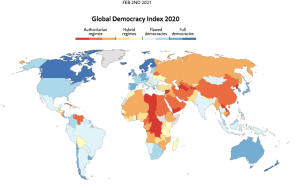
Global democracy continued its decline in 2020, according to the latest edition of the Democracy Index from our sister company, The Economist Intelligence Unit. The annual survey, which rates the state of democracy across 167 countries based on five measures—electoral process and pluralism, the functioning of government, political participation, democratic political culture and civil liberties—finds that just 8.4% of the world’s population live in a full democracy while more than a third live under authoritarian rule. The global score of 5.37 out of ten is the lowest recorded since the index began in 2006.

https://www.economist.com/graphic-detail/2021/02/02/global-democracy-has-a-very-bad-year

A manifesto for renewing liberalism

Success turned liberals into a complacent elite. They need to rekindle their desire for radicalism

For The Economist this is profoundly worrying. We were created 175 years ago to campaign for liberalism—not the leftish “progressivism” of American university campuses or the rightish “ultraliberalism” conjured up by the French commentariat, but a universal commitment to individual dignity, open markets, limited government and a faith in human progress brought about by debate and reform.

https://www.economist.com/leaders/2018/09/13/a-manifesto-for-renewing-liberalism

From the Foreign Affairs Anthology: Which World are We Living In? Liberal, Realist, Tribal, Marxist

Realist World
The Players Change, but the Game Remains

Today’s competition between China and the United States is a new twist on an old story. Until the onset of the nineteenth century, China was by far the world’s largest economy and most powerful country, with an estimated 40 percent share of global GDP. Then it entered a long decline, ravaged from without and within—around the same time the United States was born and began its long ascent to global dominance. The United States’ rise could not have occurred without China’s weakness, given how important U.S. dominance of Asia has been to American primacy. But nor could China’s revival have occurred without the United States’ provision of security and open markets.

So both countries have dominated the world, each has its own strengths and weaknesses, and for the first time, each confronts the other as a peer. It is too soon to tell how the innings ahead will play out. But we can be confident that the game will continue.

https://www.foreignaffairs.com/articles/world/2018-06-14/realist-world?fa_anthology=1122622

Liberal World
The Resilient Order

The recent rise of illiberal forces and leaders is certainly worrisome. Yet it is too soon to write the obituary of liberalism as a theory of international relations, liberal democracy as a system of government, or the liberal order as the overarching framework for global politics. The liberal vision of nation-states cooperating to achieve security and prosperity remains as vital today as at any time in the modern age. In the long course of history, liberal democracy has hit been hard times before, only to rebound and gain ground. It has done so thanks to the appeal of its basic values and its unique capacities to effectively grapple with the problems of modernity and globalization.

https://www.foreignaffairs.com/articles/world/2018-06-14/liberal-world?fa_package=1122508

Tribal World
Group Identity Is All

Humans, like other primates, are tribal animals. We need to belong to groups, which is why we love clubs and teams. Once people connect with a group, their identities can become powerfully bound to it. They will seek to benefit members of their group even when they gain nothing personally. They will penalize outsiders, seemingly gratuitously. They will sacrifice, and even kill and die, for their group.

This may seem like common sense. And yet the power of tribalism rarely factors into high-level discussions of politics and international affairs, especially in the United States.

https://www.foreignaffairs.com/articles/world/2018-06-14/tribal-world?fa_package=1122508

Marxist World
What Did You Expect From Capitalism?

After nearly every economic downturn, voices appear suggesting that Marx was right to predict that the system would eventually destroy itself. Today, however, the problem is not a sudden crisis of capitalism but its normal workings, which in recent decades have revived pathologies that the developed world seemed to have left behind.

https://www.foreignaffairs.com/articles/world/2018-06-14/marxist-world?fa_package=1122508