The Attack Of The Civilization-State

A world society seemed to be advancing. But then the civilization-state struck back.

As a civilization-state, China is organized around culture rather than politics. Linked to a civilization, the state has the paramount task of protecting a specific cultural tradition. Its reach encompasses all the regions where that culture is dominant.

The importance of this concept became more obvious to me in India during a conversation with Ram Madhav, the general secretary of the ruling Bharatiya Janata Party. After a conference in Delhi, he explained: “From now on, Asia will rule the world, and that changes everything because in Asia, we have civilizations rather than nations.”
How can nations atone for their sins?

What is the ideal approach for a nation confronting its historical crimes? In dealing with historical guilt, are nations better off working to become “normal,” or should they strive to be “exceptional”? 

But is there a way out of this impasse? We will argue that the only way to make peace with a bloody history is through exceptionalism—reckoning with what is exceptional in your own country’s story, and finding, too, a distinct and homegrown way to face up to the truth and its consequences. Those consequences, and their lessons, will after all be different for different peoples. 

https://www.prospectmagazine.co.uk/magazine/how-can-nations-atone-for-their-sins-germany-russia-nazism-soviet-union

The Dream of Open Borders Is Real—in the High Arctic

The Norwegian territory of Svalbard has been open to citizens of the world since 1920. But don’t call it a utopia.

What I discovered was a historical accident, rooted in environmental determinism and shaped by economics, that is being irreversibly upended. There’s a dismal symmetry at play: As climate change renders the rest of the planet as hostile to human life as the far north, we too must make the choice between throwing up walls and letting them down. Svalbard’s geopolitics provide an imperfect but alternative vision of how places can be governed, whom they can accommodate, and how communities can form.

https://www.thenation.com/article/archive/svalbard-arctic-open-borders/

China’s Claims to the South China Sea Are Unlawful. Now What?

Republican and Democratic administrations have failed to thwart aggressive expansion in one of the world’s busiest sea lanes. The solution isn’t flashy, but it could work.

It is, nonetheless, a message that is valid and long overdue. Over the past decade, China has steadily hardened its claims to most of the South China Sea, a zone circumscribed by a vague “nine-dash line” that one American naval commander called the “Great Wall of Sand.” The claims have included a campaign of building up shoals and militarizing islands or proclaiming municipal districts and settling people on contested islands. The reclamation of several reefs and atolls in the Spratly Islands has included construction of runways, hangars, barracks, missile silos and radar sites.

Where Will Everyone Go?

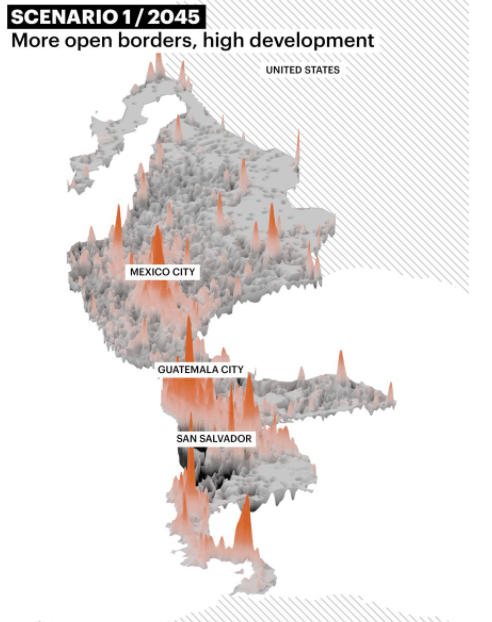
ProPublica and The New York Times Magazine, with support from the Pulitzer Center, have for the first time modeled how climate refugees might move across international borders. This is what we found.

Scientists have learned to project such changes around the world with surprising precision, but — until recently — little has been known about the human consequences of those changes. As their land fails them, hundreds of millions of people from Central America to Sudan to the Mekong Delta will be forced to choose between flight or death. The result will almost certainly be the greatest wave of global migration the world has seen.

https://features.propublica.org/climate-migration/model-how-climate-refugees-move-across-continents/

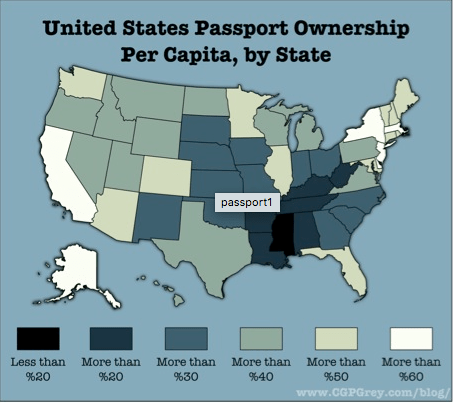
America’s Great Passport Divide

This topic connects well to concepts related to populism, Brexit, Republican-Democratic Divide, and the concept of “Anywheres” vs. “Somewheres” to explain schisms within western societies

How income, education, and other factors influence our propensity for globe-trotting

Passport holding also reflects something about the underlying personality of places.  American states are not only sorting by income, education and political orientation, but by personality type, according to research by the Cambridge University psychologist Jason Rentfrow and his colleagues.  Passport holding is in fact related to three of the five major personality types.  There are positive correlations between passports and Openness-to-Experience personalities, and negative ones to both Agreeableness and Conscientiousness.  “The results suggest to me that this is also linked to Openness,” Rentfrow noted after looking over these findings. “Openness is about curiosity and adventure, so it would make sense that Open places have high numbers of passports.” 

https://www.theatlantic.com/national/archive/2011/03/americas-great-passport-divide/72399/

For Nagorno-Karabakh’s Dueling Sides, Living Together Is ‘Impossible’

Armenians and Azerbaijanis coexisted in Soviet days. But conflict over the disputed territory exploded in the late 1980s, leaving festering wounds that have erupted anew.

Armenians and Azerbaijanis lived side by side in the Soviet days, until conflict over the disputed mountain territory called Nagorno-Karabakh exploded in the late 1980s into riots, expulsions and a yearslong war. The violence left personal wounds festering for decades, as stubborn as the tan and gray stone ruins of Azerbaijani villages still scattered in the Armenian countryside.

Why the Ukraine Crisis Is the West’s Fault

The Liberal Delusions That Provoked Putin

U.S. and European leaders blundered in attempting
to turn Ukraine into a Western stronghold on Russia’s border. Now
that the consequences have been laid bare, it would be an even greater
mistake to continue this misbegotten policy.

https://www.mearsheimer.com/wp-content/uploads/2019/06/Why-the-Ukraine-Crisis-Is.pdf?fbclid=IwAR15dye1l5EyS5JL3ifNam0-SILfqe0OKlthFtGMbAcmEN0HU5aDyXsBNoo