The Life After: Fifteen years after the genocide in Rwanda, the reconciliation defies expectations.

Gacaca was designed to reward confessions, because the objective was not only to render rudimentary justice and mete out punishment but also to allow some emotional catharsis by establishing a collective accounting of the truth of the crimes in each place where they were committed. During a trial run of gacaca courts, in 2005, there were many reports of corrupt judges, and of intimidated witnesses, including an alarming number of cases in which genocide survivors were murdered before they could testify.

https://www.newyorker.com/magazine/2009/05/04/the-life-after
A Love Of Sovereignty: Borders, Bureaucracy And The Rohingya Crisis – Analysis

As hordes of experts and analysts fumble through the politics of the Rohingya crisis misrepresenting it as a communal or religious problem, the state and its sponsors conjure up ever more systematic and violent techniques to establish sovereignty over Myanmar’s problematized Rohingya. The Australian government has provided over AUS$5 million to Myanmar to help ‘strengthen border control’ with the aim of tackling ‘illegal cross border movement’. Myanmar government officials have made it clear that for the state it is the Rohingya who constitute the largest threat to sovereignty (Zarni & Cowley, 2014).

https://www.eurasiareview.com/22122015-a-love-of-sovereignty-borders-bureaucracy-and-the-rohingya-crisis-analysis/

Teaching About the Rohingya Crisis in Myanmar With The New York Times

Why are hundreds of thousands of Rohingya refugees fleeing Myanmar? Who are the Rohingya and why are they being persecuted? What responsibility does the world have to end what the United Nations is calling “ethnic cleansing” and many are labeling “genocide”?

In this lesson, students will first learn about the crisis unfolding in Myanmar using Times reporting, videos, podcasts and photography. Then, we suggest a variety of activities for going deeper, such as tackling universal questions about national identity and minority rights, considering the responsibility of the world community, and going inside the squalid refugee camps sprawling across the border in Bangladesh. And, we suggest ways students can take action and have their voices heard.

China’s ‘purification’ of classrooms: A new law erases history, silences teachers and rewrites books

With China’s tightening control over Hong Kong, including passage of a new national security law, the territory’s pro-democracy activists, politicians, journalists and others are facing a Communist Party determined to crush dissent. Perhaps the greatest threat from this new purge — one that will affect generations to come — is the increasing pressure on schools and teachers over what to put in the minds of students. Both activists and bureaucrats know that a nation’s soul is distilled in the classroom; history can be erased with the silencing of teachers and rewriting of textbooks.

https://www.latimes.com/world-nation/story/2020-09-11/hong-kong-teacher-purge

‘Kill All You See’: In a First, Myanmar Soldiers Tell of Rohingya Slaughter

Video testimony from two soldiers supports widespread accusations that Myanmar’s military tried to eradicate the ethnic minority in a genocidal campaign.

On Monday, the two men, who fled Myanmar last month, were transported to The Hague, where the International Criminal Court has opened a case examining whether Tatmadaw leaders committed large-scale crimes against the Rohingya.

The atrocities described by the two men echo evidence of serious human rights abuses gathered from among the more than one million Rohingya refugees now sheltering in neighboring Bangladesh. What distinguishes their testimony is that it comes from perpetrators, not victims.

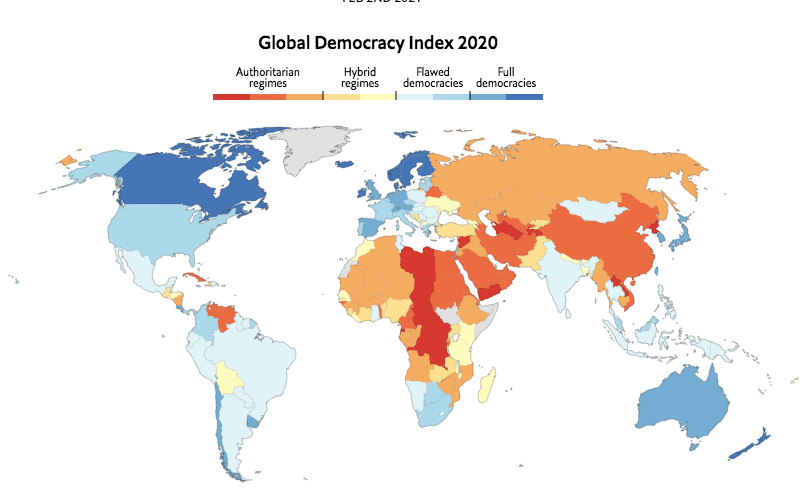
Global democracy has a very bad year

The pandemic caused an unprecedented rollback of democratic freedoms in 2020

Government-imposed lockdowns and other pandemic-control measures led to a huge rollback of civil liberties in 2020, causing downgrades across the majority of countries. Confronted by a new, deadly disease to which humans had no natural immunity, most people concluded that preventing a catastrophic loss of life justified some temporary loss of freedom. The ranking penalised countries that withdrew civil liberties, failed to allow proper scrutiny of emergency powers or denied freedom of expression—regardless of whether there was public support for government measures. In France for example, severe lockdowns and national curfews led to a small but significant decrease in its overall score and the country dropped into the “flawed democracy” category.

https://www.economist.com/graphic-detail/2021/02/02/global-democracy-has-a-very-bad-year

Top international court rejects Uighur calls to investigate China for alleged genocide

The office of prosecutor Fatou Bensouda said the ICC couldn’t act because China is not a signatory to the court.

The Uighurs had argued that even though the alleged deportations did not happen on Chinese soil, the ICC could act because they happened on Tajik and Cambodian territory, and both of them are ICC members.

https://www.sbs.com.au/news/top-international-court-rejects-uighur-calls-to-investigate-china-for-alleged-genocide/e20763c3-33be-48fc-8941-1a07945b5a96

‘It’s cultural genocide’: inside the fight to stop a pipeline on tribal lands

The Line 3 route traverses land that Native American pipeline opponents say is protected by US treaties with Ojibwe nations

There are numerous sites in Minnesota, along the new Line 3 route, where water protectors have set up camp. Much of the route goes through tribal lands, as well as Minnesota’s iron range and areas popular for recreation, including hunting, fishing and people enjoying the outdoors.

It is a lush, wooded part of the state, thick with birch and pine trees, pristine lakes, rolling creeks and lakes filled with wild rice, an agricultural product that is historically significant to the Ojibwe.

https://www.theguardian.com/us-news/2021/feb/19/line-3-pipeline-ojibwe-tribal-lands

Border Insecurity: The Border Patrol’s sweeping powers inside the U.S. lack accountability and perpetuate racial profiling.

At dozens of internal checkpoints across the country, Border Patrol agents stop and question passing motorists on their citizenship. Elsewhere, officers engage in roving traffic stops aimed at interdicting illegal immigration inside the United States. Agents at checkpoints require neither a warrant nor individualized suspicion to stop passing motorists and inquire about the occupants’ citizenship, or to inspect private lands within twenty-five miles of the border. Taken together, these “defense in depth” measures amount to an extraordinarily expansive law enforcement effort carried deep into the U.S. interior.

https://www.persuasion.community/p/border-insecurity