American power ($)

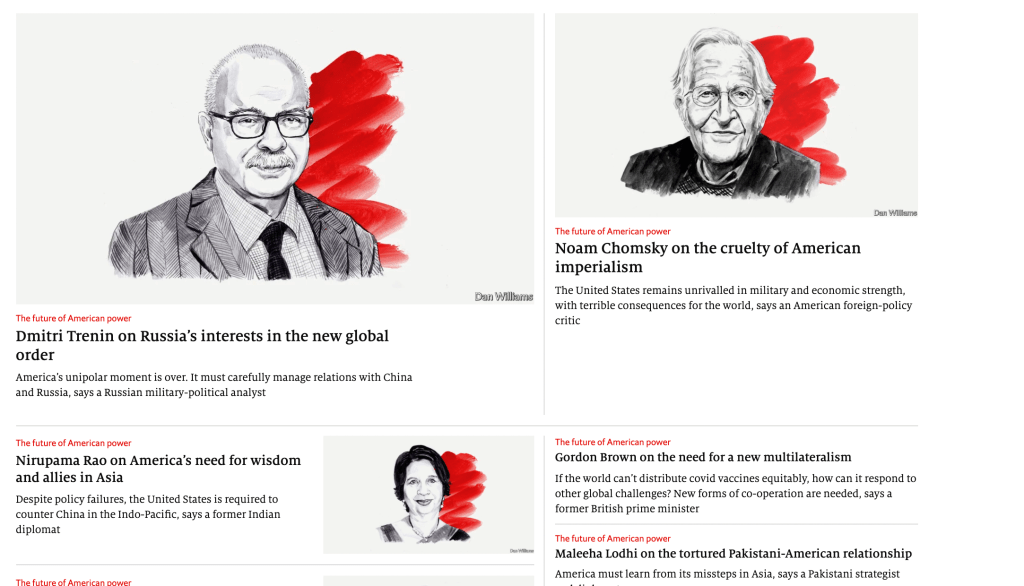
The global order that America helped to establish in the second half of the 20th century is changing fast. In this collection of commentaries, global thinkers examine the sources of America’s power and the forces changing it. They offer predictions and prescriptions for the future. The series looks broadly at America’s power, from its chaotic abandonment of Afghanistan to the rise of China. It also considers the internal forces at work in the United States.

https://www.economist.com/future-of-american-power

Why is China smashing its tech industry?

Maybe because what countries think of as a “tech industry” isn’t always the same 

In other words, the crackdown on China’s internet industry seems to be part of the country’s emerging national industrial policy. Instead of simply letting local governments throw resources at whatever they think will produce rapid growth (the strategy in the 90s and early 00s), China’s top leaders are now trying to direct the country’s industrial mix toward what they think will serve the nation as a whole.

https://noahpinion.substack.com/p/why-is-china-smashing-its-tech-industry

China’s Big Bet on Soft Power

China is believed to spend billions of dollars to boost its international image, but it has yet to see a marked return on its investment in soft power.

China is a powerful international actor as the world’s most populous country and its second-largest economy. The country also invests significantly in modernizing its military. With signs that the United States will retreat from a leadership role under the Trump administration, China has positioned itself as a champion of globalization and economic integration, perhaps signaling a desire to step in as a greater international leader. It is doing this by doubling down on soft power, a measure of a country’s international attractiveness and its ability to influence other countries and publics.

https://www.cfr.org/backgrounder/chinas-big-bet-soft-power

Planet Money Podcast: Hong Kong

Jimmy was born in mainland China. In 1960, when he was 12 years old, he snuck out of China and into Hong Kong by hiding in the bottom of a fishing boat. The day he got to Hong Kong, he got a job in a factory. By the time he was 21, he was running a factory. Today, he’s one of the richest people in Hong Kong. He’s also one of the most vocal critics of the Chinese government, and a major figure in Hong Kong’s protest movement.

Jimmy Lai’s story is the story of Hong Kong. And Hong Kong’s story is the story of the 200-year-long history of China and with the West — a story of communism, colonialism, and capitalism.

https://www.npr.org/2019/07/19/743480237/episode-928-hong-kong

Underwater: Human Rights Impacts of a China Belt and Road Project in Cambodia

This report, based on interviews with over 60 people over two years, shows how officials within the Cambodian government, and CHNG and its subsidiaries, did not adequately consult with impacted communities and affected families before or during the construction of the Lower Sesan 2 dam. It documents how officials ignored communities’ concerns and objections, dismissed calls for discussion of alternative project designs, provided wholly inadequate compensation to impacted communities, and failed to set up an effective grievance mechanism to address disputes. Government and company officials made no attempt to obtain the “free, prior, and informed consent” of affected Indigenous peoples, as specified under the United Nations Declaration on the Rights of Indigenous Peoples.

https://www.hrw.org/report/2021/08/10/underwater/human-rights-impacts-china-belt-and-road-project-cambodia

(Above is the full report, below is a shorter news story about the report)

Alleged abuses linked to China’s ‘Belt and Road’ projects: report

Almost a third of the alleged abuses recorded from 2013 to 2020 have taken place in Southeast Asia, including Myanmar, Laos, Cambodia and Indonesia.

https://www.aljazeera.com/news/2021/8/11/china-belt-and-road-dam-a-rights-disaster-for-cambodia-report
China: The Land That Failed to Fail

During this time, eight American presidents assumed, or hoped, that China would eventually bend to what were considered the established rules of modernization: Prosperity would fuel popular demands for political freedom and bring China into the fold of democratic nations. Or the Chinese economy would falter under the weight of authoritarian rule and bureaucratic rot.