U.S. Airstrikes Killed at Least 22,000 Civilians Since 9/11
September 12, 2021
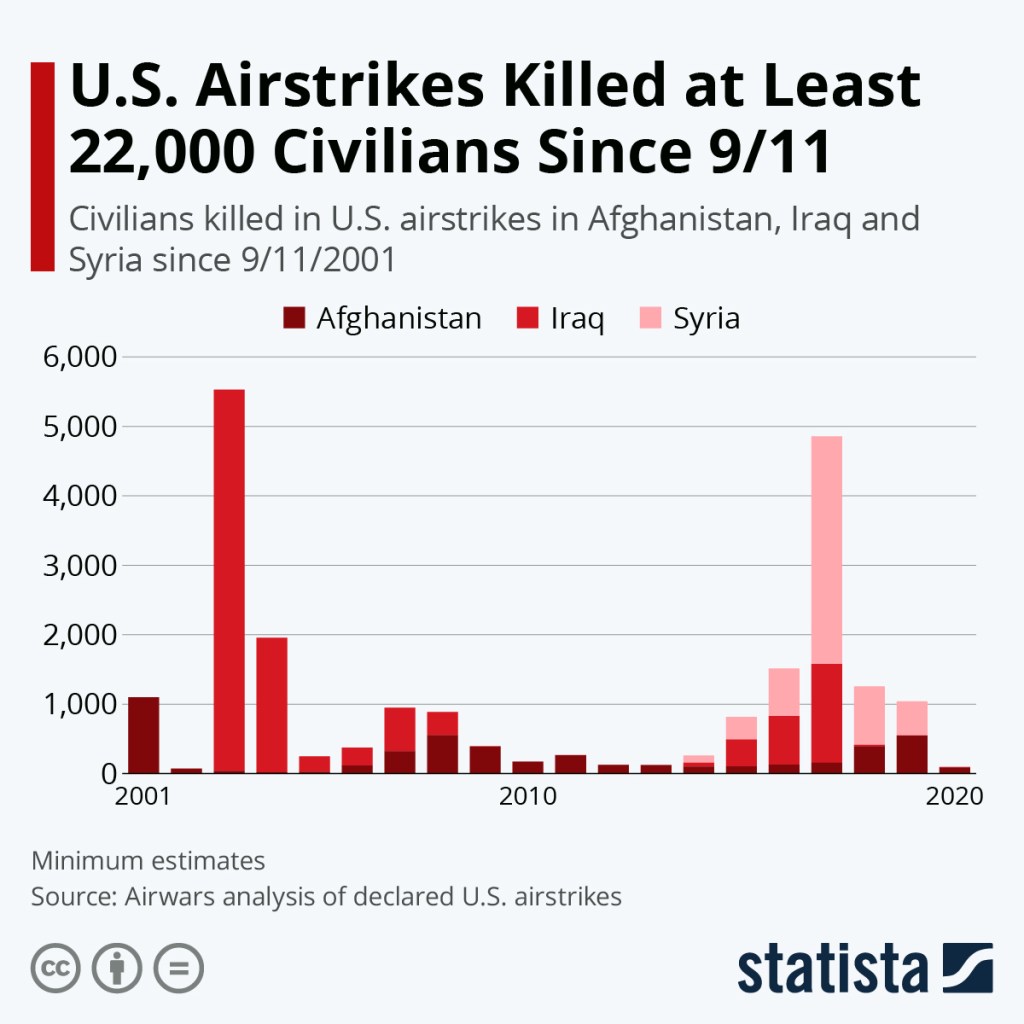
The U.S. occupation of Afghanistan sacrificed politics—the only viable route to peace—for massive corruption and violence, all committed in the name of humanitarian compassion.
“The idea that we’re able to deal with the rights of women around the world by military force is not rational.” This single sentence from President Biden’s ABC interview with George Stephanopoulos on August 18 exposed the paradox of humanitarian intervention. It acknowledged that trying to address violence with violence only serves to perpetuate it.
https://bostonreview.net/war-security/faisal-devji-violent-logic-humanitarianism
Military officers like me thought we were building a capable Afghan security force. What did we get wrong? Plenty.
https://www.theatlantic.com/ideas/archive/2021/08/how-america-failed-afghanistan/619740/
Political and ethnic tensions have fueled new discord — and the Taliban has capitalized on these grievances
With Kabul close to collapse, Shadi and Damir argue about the nature of the multiple screwups in Afghanistan, both long-term and of more recent vintage. What exactly is Biden doing wrong? Should we stay a bit longer, and if so, to what end? And what lessons should Americans learn from all if it?
https://wisdomofcrowds.live/afghanistan-and-americas-liberal-empire/
Joe Biden claimed “zero” parallels between U.S. withdrawals from Afghanistan and Vietnam. As the Taliban take Kabul, he’s proved wrong.
https://theintercept.com/2021/08/15/afghanistan-taliban-kabul-fall-saigon/
The U.S. has a responsibility to protect Afghans from the mass atrocities of the Taliban.
https://frenchpress.thedispatch.com/p/when-never-again-becomes-again-and
https://weekly.thedispatch.com/p/our-best-stuff-from-a-frustrating
Meanwhile, the debate about intervention for human protection purposes has not gone away. And it will not go away so long as human nature remains as fallible as it is and internal conflict and state failures stay as prevalent as they are. The debate was certainly a lively one throughout the 1990s. Controversy may have been muted in the case of the interventions, by varying casts of actors, in Liberia in 1990, northern Iraq in 1991, Haiti in 1994, Sierra Leone in 1997, and (not strictly coercively) East Timor in 1999. But in Somalia in 1993, Rwanda in 1994, and Bosnia in 1995, the UN action taken (if taken at all) was widely perceived as too little too late, misconceived, poorly resourced, poorly executed, or all of the above. During NATO’s 1999 intervention in Kosovo, Security Council members were sharply divided; the legal justification for action without UN authority was asserted but largely unargued; and great misgivings surrounded the means by which the allies waged the war.
https://www.foreignaffairs.com/articles/2002-11-01/responsibility-protect
The US, which deploys more drones than any other country, has exploited the gaps in international law to fight its war on terror.
The principle of humanity requires avoiding unnecessary harm to civilians. The fundamental rationale for drone use relies on this principle: drone capacity for precise targeting can save civilian lives. US Air Force General T Michael Moseley calls this the “true hunter-killer role” of drones. Given that there were, for example, two million civilian deaths in the Korean War alone, the precision of drone strikes offers a persuasive moral argument in favour of their use
https://www.newstatesman.com/world/north-america/2019/11/are-drone-strikes-ever-ethical
Samantha Power made a career arguing for America’s “responsibility to protect.” During her years in the White House, it became clear that benevolent motives can have calamitous results.
The book inspired a generation of activists, helping to establish the doctrine of “responsibility to protect,” which held that the United States and other wealthy countries had an obligation to defend threatened populations around the world. It also made a star of its author, a charismatic, cracklingly smart presence who urged others to take up the cause. “Know that history is not in a hurry but that you can help speed it up,” she told Yale’s graduating class of 2016. “It is the struggle itself that will define you. Do that, and you will not only find yourself fulfilled but you, too, will live to see many of your lost causes found.”
https://www.newyorker.com/magazine/2019/09/16/the-moral-logic-of-humanitarian-intervention
Originally devised by Greek and Roman philosophers, the “just war theory” was developed by Christian theologians. With some variations, it is widely cited and applied by various religions today.
Here we outline the six steps to a just war and square them with the issues at stake.
http://news.bbc.co.uk/2/hi/uk_news/politics/2724019.stm
The war can be waged only as a last resort, with all nonviolent options exhausted. In the case of Iraq, it is obvious that clear alternatives to war exist. These options — previously proposed by our own leaders and approved by the United Nations — were outlined again by the Security Council on Friday. But now, with our own national security not directly threatened and despite the overwhelming opposition of most people and governments in the world, the United States seems determined to carry out military and diplomatic action that is almost unprecedented in the history of civilized nations. The first stage of our widely publicized war plan is to launch 3,000 bombs and missiles on a relatively defenseless Iraqi population within the first few hours of an invasion, with the purpose of so damaging and demoralizing the people that they will change their obnoxious leader, who will most likely be hidden and safe during the bombardment.
American forces are in Iraq at the invitation of the Iraqi government, and they have every right and authority to defend themselves. This legal act of self-defense was not only proportionate — it was targeted and brilliantly executed, causing essentially no collateral damage.
So the killing was justified and legally sound.
 An IB Global Politics Site