20 Hungarian Lessons the West Is Still Missing

While most recent interest has tended to focus on the behavior of the Orbán government or its opponents in the EU, Hungary’s current moment in the spotlight seems to be mostly due to outsiders arguing over whether and how it might serve as either a model or cautionary tale. Unsurprisingly, this argument has mostly used Hungary as a proxy for domestic dramas. And unfortunately, it is likely that the spotlight will move on, with relatively little attention paid to many of the lessons the country actually can offer to Right, Left, and center.

https://quillette.com/2021/08/13/20-hungarian-lessons-the-west-is-still-missing/
“Anywheres” vs. “Somewheres” A framework for understanding populism

The Anywheres constitute about 25 percent of the British population, but they dominate the political class, and it is their concerns that are paramount in public policy. The Anywheres favor “progressive individualism.” They place a “high value on autonomy, mobility, and novelty” and a “much lower value” on “faith, flag, and family.” Anywheres are “comfortable with immigration, European integration, and . . . human-rights legislation,” which “dilute the claims of national citizenship.”

In contrast to the people who see the world from “anywhere” are the people who see the world from “somewhere.” The Somewheres are more rooted and socially conservative, older, with less formal education but a greater attachment to tradition, the Crown, and the nation. 

https://www.nationalreview.com/magazine/2017/07/31/david-goodhart-the-road-to-somewhere/

The demise of the nation state

After decades of globalisation, our political system has become obsolete – and spasms of resurgent nationalism are a sign of its irreversible decline. By Rana Dasgupta

When we discuss “politics”, we refer to what goes on inside sovereign states; everything else is “foreign affairs” or “international relations” – even in this era of global financial and technological integration. We may buy the same products in every country of the world, we may all use Google and Facebook, but political life, curiously, is made of separate stuff and keeps the antique faith of borders.

https://www.theguardian.com/news/2018/apr/05/demise-of-the-nation-state-rana-dasgupta

Bound to Fail: The Rise and Fall of the Liberal International Order

I offer three main sets of arguments. First, because states in the modern world are deeply interconnected in a variety of ways, orders are essential for facilitating efficient and timely interactions. There are different kinds of international orders, and which type emerges depends primarily on the global distribution of power. But when the system is unipolar, the political ideology of the sole pole also matters. Liberal international orders can arise only in unipolar systems where the leading state is a liberal democracy.

https://direct.mit.edu/isec/article/43/4/7/12221/Bound-to-Fail-The-Rise-and-Fall-of-the-Liberal#.Xt2mKjLdbEM.twitter

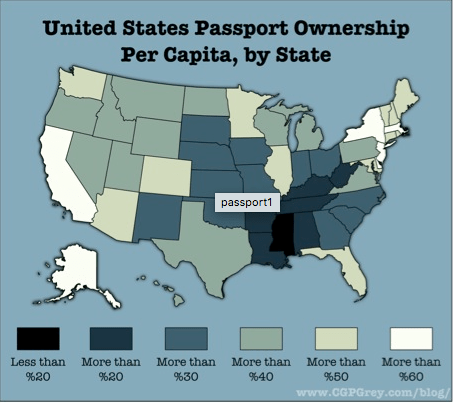
America’s Great Passport Divide

This topic connects well to concepts related to populism, Brexit, Republican-Democratic Divide, and the concept of “Anywheres” vs. “Somewheres” to explain schisms within western societies

How income, education, and other factors influence our propensity for globe-trotting

Passport holding also reflects something about the underlying personality of places.  American states are not only sorting by income, education and political orientation, but by personality type, according to research by the Cambridge University psychologist Jason Rentfrow and his colleagues.  Passport holding is in fact related to three of the five major personality types.  There are positive correlations between passports and Openness-to-Experience personalities, and negative ones to both Agreeableness and Conscientiousness.  “The results suggest to me that this is also linked to Openness,” Rentfrow noted after looking over these findings. “Openness is about curiosity and adventure, so it would make sense that Open places have high numbers of passports.” 

https://www.theatlantic.com/national/archive/2011/03/americas-great-passport-divide/72399/

Book: The Tyranny of Merit by Michael Sandel

This book covers a lot of ground but Chapter 1, titled “Winners and Losers,” makes an interesting case that the use and abuse of the concept of “merit” is what led to populist backlashes of Donald Trump’s election and Brexit. 

You can actually read the whole introduction and first chapter on Amazon by clicking the “Look Inside” image of the book.


Below are a couple of links to reviews or interviews with Sandel in which he outlines his basic ideas.

Click to access tyranny-of-merit-transcript.pdf


https://www.theguardian.com/books/2020/sep/06/michael-sandel-the-populist-backlash-has-been-a-revolt-against-the-tyranny-of-merit


Is This the End of Neoliberal Globalization? ($)

The ideology underpinning neoliberal globalization demands that all markets and exchanges, large and small, global and local, be optimized for profit. This has been the mantra of corporate executives and elites for the past four decades. Empty hospital beds cost money. Local production is too expensive. Stockpiles of surgical masks and ventilators are a waste of money. Community hospitals in poor and rural counties won’t turn a profit, so they must be closed.

https://jacobinmag.com/2020/05/is-this-the-end-of-neoliberal-globalization


https://drive.google.com/file/d/1u15wh_L6g3Re5nBgzwZohhhPNhdwZ42H/view?usp=sharing